
Drive solutions for the aerospace industry
The aerospace sector has been one of the industries in which ATE has been active for many years. In most cases, the focus is not on new development, but on the reliable transition of existing designs into reproducible series production – for rotors, stators and electric motors for the subsystems of modern aircraft and spacecraft.
Where ATE plays a key role in the aviation & aerospace sector

Climate Control & Air Systems
Electric drives for environmental control systems (ECS), as well as blowers and fans.
Pumps & Compressors
Drive components for electric pumps, compressors, and fuel and lubrication oil pumps.
Actuation & Positioning
Electric drives for electromechanical and electrohydrostatic actuators, as well as positioning and deployment mechanisms.
Starter-Generators & Power Systems
Components for starter-generators and motor-generator units in aerospace-specific power systems.
Customized Rotor & Stator Systems
Application-specific rotors, stators and windings for electric machines in aerospace subsystems.
Engineering & Test Bench Applications
Support in electric machine development and test bench applications for aerospace-specific subsystems.
What makes the drive task challenging
In the aerospace sector, it is not only the electrical properties of the machine that count, but also the repeatability of its manufacture. Four factors determine the design.
Every gramme affects the efficiency of the overall system, whilst power and functionality increase. This calls for compact designs, optimized magnetic circuits, high-performance windings and efficient use of materials.
Tight installation spaces and high power density create demanding thermal constraints – winding temperature, heat dissipation and the insulation system must reliably cope with both continuous and peak loads. Added to this are the operating conditions themselves: temperature ranges, vibration, shock and – depending on the application – vacuum are already taken into account in the design.
This is where the real difference lies: it is not the machine’s one-off performance that counts, but its consistent performance across every production run. Reproducible processes, defined quality standards, stable electrical characteristics and reliable delivery capability are decisive for suitability for series production.
Drives must integrate seamlessly into complex subsystems – via mechanical interfaces, shaft and flange geometries, electrical connections, sensor technology and housing integration. In particular, the integration of stators into existing assemblies requires close coordination between development and production.
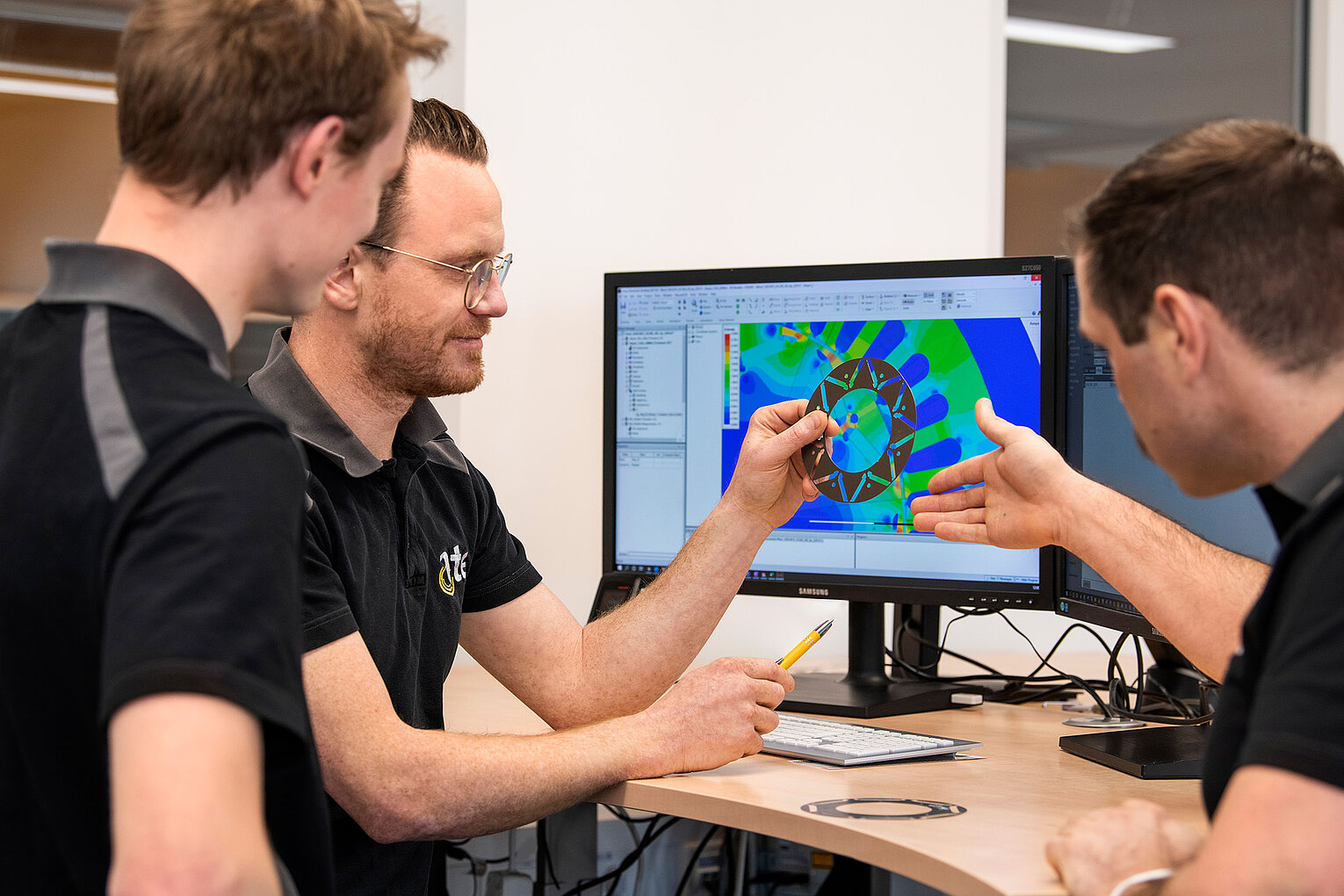
Standard motors reach their limits as soon as defined interfaces, special geometries or demanding integration requirements come into play. In the aerospace sector, there is a second factor that often carries greater weight: an existing, functioning design should not be reinvented, but rather transitioned into stable, repeatable series production.
Limited installation space, low weight, specialised housing designs, high demands on repeatability and on-time delivery – at this point, a standard solution becomes a component and manufacturing challenge. This is precisely where ATE comes in: in tailoring rotors, stators and electric motors to the application and its series production requirements.
How ATE approaches such tasks
Understanding requirements
Specifications and drawings, load profiles, speed and torque ranges, installation space, interfaces, cooling concept, manufacturing constraints, test requirements, production volumes and series production targets. The foundation for a technically and economically sound implementation.Designing or adopting components
Rotors, stators and windings – whether for synchronous or asynchronous motors, compact special-purpose motors or high-speed machines. ATE develops new designs or adopts existing ones. Depending on the project, this may involve individual components or a complete motor.Ensuring production and industrialisation
At the heart of many aerospace projects: translating existing designs into reproducible processes – through sample and prototype production, pre-series assembly, production optimization and documented, stable series production processes.Thinking ahead about integration
Mechanical and electrical interfaces, sensor technology, cooling and housing integration – right through to the assembly and potting of stators directly into the customer’s assembly.What goes into this
Stator integration for a fan in an air-conditioning system
Initial situation: A system supplier is developing an electric fan for an air-conditioning system in an aircraft. The basic design of the drive is in place – however, the installation space, weight, thermal requirements and the required repeatability place high demands on the implementation.
ATE solution: Manufacture and winding of the stators, integration directly into the customer’s fan housing, potting of the assembly in accordance with application specifications, production of prototypes and pre-series units, and transition to reproducible series production – including technical coordination for production-oriented adaptations.
Result: An integrated, production-ready solution that fits seamlessly into the existing assembly and meets the requirements for quality, reliability and repeatability.
FAQs
Yes. In addition to individual motor components, ATE also provides support, where required, for the development of complete electric motors and drive units.
Yes. Many projects are based on existing specifications and designs, which ATE translates into stable manufacturing processes and industrialises.
These include rotors, stators, windings and other motor components and assemblies for electric drive systems.
Yes. ATE supports projects from sample and prototype production through pre-series to series production.
Yes. ATE supports development projects and system suppliers with bespoke rotors, stators and electric motors for aerospace applications. The focus is on the electric machine and its integration into the respective subsystem.
Yes. Depending on the application, ATE handles the assembly and potting of stators directly into the customer’s housings, thereby supporting integration into existing systems.

Tailoring drive solutions
Are you looking for a partner to develop or manufacture rotors, stators and electric motors for aerospace applications?
ATE supports you from initial prototype production right through to reproducible series production – with high manufacturing quality and a clear focus on the requirements of your application.
Call us on
+49 (0) 7561-98248-286
Send us a message to
u.ertel(at)ate-system.de