
Drive solutions for medical technology
In medical devices, the drive does more than just provide motion: it determines dosing accuracy, smooth operation and temperature behaviour – and must fit into an installation space that is becoming ever more confined. Where all these factors come together, standard motors quickly reach their limits.
Where ATE comes into its own in medical technology

Surgery & Handheld Instruments
Drive components for surgical instruments and handheld tools, high-speed dental handpieces, surgical robotics and precision actuation.
Pumps, Ventilation & Fluid Handling
Drive solutions for infusion, insulin, dialysis and fluid pumps, as well as ventilators, blowers and air and gas handling modules.
Diagnostics & Laboratory Automation
Electric drives for diagnostic and imaging systems, laboratory automation and IVD systems, as well as pipetting and sample handling applications.
Rehabilitation & Prosthetics
Drive components for prosthetics, rehabilitation systems and assistive drives used in patient care.
Customized Rotor & Stator Systems
Application-specific rotors, stators and windings for compact, precise electric machines in medical applications.
Integrated Medical Assemblies
Customized drive components and integrated assemblies for incorporation into medical devices and systems.
What makes the drive task challenging
In medical technology, requirements converge that exacerbate one another: precision within the tightest installation space, high rotational speed with minimal vibration, and performance with controlled heat dissipation. Five factors determine the design.
Many applications require precisely reproducible movements – constant flow rates, defined positioning, and stable control performance across every start-stop cycle. The drive ensures that the device’s operation can be controlled with precision and repeatability.
Noise and vibration are not merely a matter of comfort here, but an integral part of the function: they influence measurement accuracy, haptic feedback and usability. Balanced rotors, precise mass design and controlled dynamics are therefore part of the specification.
As devices become smaller, the drive becomes a challenge of integration – high power density within a short overall length. Hand tools and laboratory applications demand both high speeds and rapid motion sequences; ATE develops micro-drives capable of speeds in the six-figure range.
Heat generation affects performance, service life and usability on patients. And where cleaning or sterilisation form part of the application profile, the choice of materials, sealing and encapsulation must be suitable from the outset – not as an afterthought.
Development and manufacture must meet the quality requirements of the resulting medical device: documented processes, defined tests, stable electrical properties, traceable changes and reproducible, series-production-ready manufacturing.
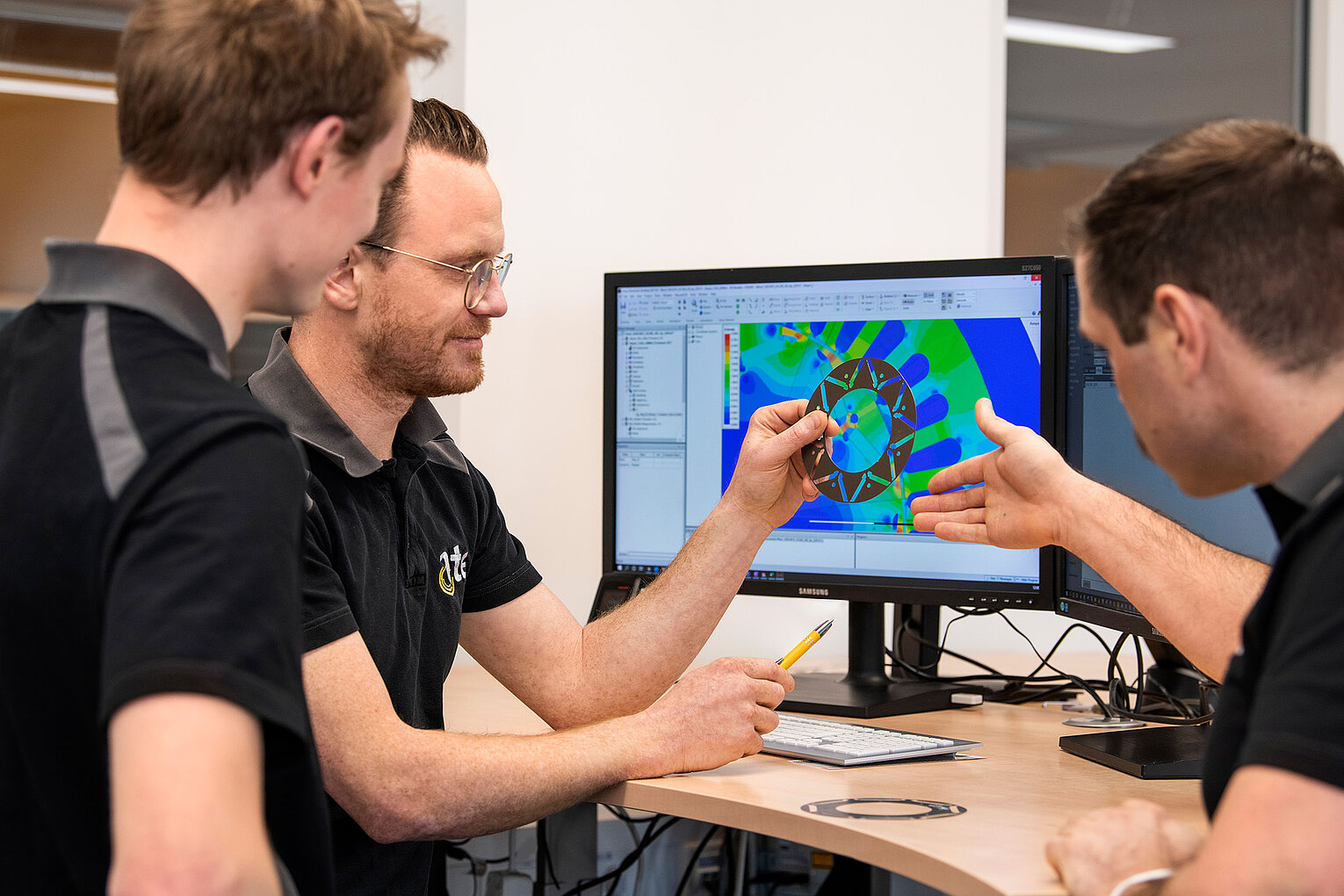
Standard motors reliably fulfil many tasks, provided that speed, torque, installation space and interfaces remain within known limits. In medical technology, the challenge almost always arises from a combination of factors – not from a single requirement.
A very compact design, low noise and vibration levels, high speed, precise controllability, hygiene or sterilisation requirements, and validatable series production: at the very latest when it comes to surgical hand tools, precision pumps, ventilator blowers or customized rotor-stator units, the drive must be designed for the actual application.
How ATE approaches such tasks
Clarify requirements
Function and application profile, speed, torque, power, load profile and duty cycle, installation space, noise and vibration specifications, temperature behaviour, cleaning and sterilisation requirements, sensor technology, interfaces, target production volumes and validation requirements.Designing the drive
Motor technology, rotor, stator and windings – optimized for speed stability, smooth running, thermal behaviour and mechanical strength. Depending on the project, individual components or a complete motor.Consider integration
Electronics, sensor technology, shaft geometry, bearings, housing, cooling, pump or tool mechanics and hygiene requirements are considered as part of the overall unit, not as afterthoughts.Preparing for implementation
From functional prototypes through to prototypes, test benches and validation within the actual operating window, right through to industrialisation and series production. Development and manufacturing under one roof.What goes into this
Customized pump drive for a medical fluidics module
Initial situation: A manufacturer is developing a compact medical device with a defined pumping function. The drive must be precisely controllable, generate minimal vibration, remain thermally stable and integrate into a compact housing with specified interfaces to electronics, sensors and mechanical components.
ATE solution: Customized rotors, application-specific stators and windings, design tailored to the flow profile and duty cycle, electromagnetic and thermal optimization, tailored to the noise and vibration requirements and to integration into the existing assembly.
Result: A drive solution tailored to the application, offering precise operational behaviour, high integrability and reproducible series production.
FAQs
When speed, torque, installation space, noise, vibration, heat generation, hygiene requirements or interfaces no longer fit a standard motor.
The following are helpful: function, load profile, speed, torque, installation space, temperature range, sensors, electronics and target production volumes. Not all of these need to be finalised from the outset.
Precise speed control, constant flow rates, pump performance curve, noise levels, heat generation and integration into the fluidic module.
High speeds, low vibration, controlled heat generation, a compact installation space and reliable operation within the defined application profile.
They influence ease of use, measurement accuracy, haptic feedback and integration into sensitive device environments.
Electromagnetic design, thermal and strength analysis, power and speed measurements, as well as validation within a realistic operating window.

Tailoring drive solutions
Are you developing a medical device, a pump, a hand tool, a blower, a diagnostic module or a laboratory automation assembly with specific requirements regarding precision, installation space, smooth operation, thermal management or integration?
ATE supports you in the development of customized rotors, stators and electric motors – from functional prototypes through to series production.
Call us on
+49 (0) 7561-98248-23
Send us a message to
r.zell(at)ate-system.de